
Fence Lines and Property Boundaries Reclaimed
Brush and overgrowth clearing in Nacogdoches for properties where vegetation has blocked usable land or created fire risk along boundaries
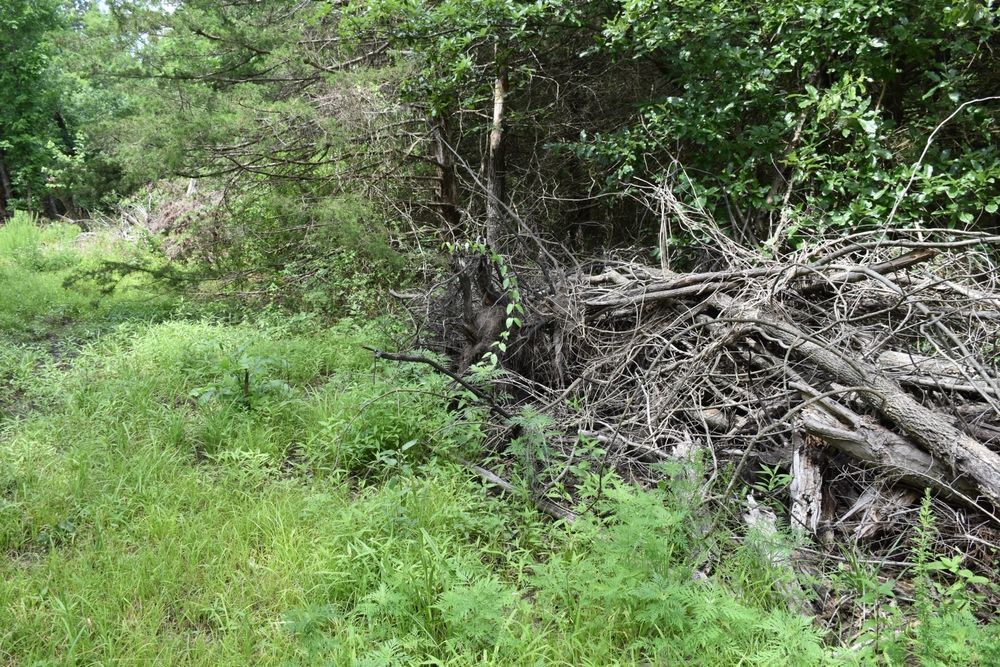
Properties throughout the Nacogdoches area accumulate brush along fence lines and boundary edges over years of minimal attention—cedar, yaupon, and fast-growing scrub that starts as a strip and becomes a dense wall. That growth blocks usable land, creates fire risk, and makes fence line access and maintenance impossible without first cutting through the overgrowth. Get-R-Done Land Services clears that vegetation and hauls it away, restoring the boundary to a condition you can actually work with.
The clearing approach depends on site access and density. A skid steer handles large volumes quickly on sites where equipment can move freely. Hand crews are deployed on sections where tree spacing or terrain makes machine access impractical. Vegetation is cut, pulled, and either chipped on site or hauled away completely—the finished state is cleared ground, not cut stems left to re-root. Work proceeds to the property lines and around obstacles you identify before clearing begins, and widening a fence line or cleaning an adjacent area that needs attention is routinely included at no charge.
Schedule a free estimate to walk the boundary and confirm the clearing scope before mobilizing equipment or crews.
Why Brush Returns and How to Stop It
The reason overgrowth returns after surface-level clearing is that most fast-growing East Texas brush species—yaupon holly in particular—resprout aggressively from root systems left in the ground. Cutting alone extends the maintenance cycle by months at best. Pulling or grinding the root mass during clearing, rather than just cutting at grade, is what separates a clearing job that holds for years from one that needs repeating the following season. Get-R-Done Land Services removes vegetation at the root rather than cutting the visible growth and leaving the problem in place.
After clearing is complete, the difference is visible immediately: fence lines are accessible, boundaries are defined, and the land previously blocked by growth is open and available. Property owners commonly discover usable acreage they had written off as inaccessible once the vegetation layer is removed and hauled away. All debris leaves the site as part of the job—there is no pile left for the property owner to deal with separately.
Dense mature growth along a fence line that has gone unmanaged for several years may require sequential passes—machine work to break down the bulk, followed by hand crew work in tight sections near fence posts and corners. The operator assesses the sequence on arrival rather than committing to a single method before seeing site conditions up close.
Common Questions About This Service
Brush clearing questions tend to focus on what gets removed, how deeply, and what the boundary looks like afterward. The answers below reflect how clearing decisions are made on properties with varying density and access.
How does the crew decide whether to use a skid steer or hand crews for a clearing job?
Site access and vegetation density drive that decision. Where equipment can move without damaging established areas, a skid steer processes volume faster. In tight sections near fences, structures, or dense tree stands, hand crews work in areas the machine can't reach without causing collateral damage.
What happens to the debris once it's cleared?
Vegetation is chipped on site or loaded and hauled away entirely. Nothing is left in windrows or piled at the property edge—the cleared area is clean when the crew leaves.
How close to a fence line can clearing be performed without damaging the fence?
Hand crews work directly along fence lines where needed, trimming and pulling growth without disturbing fence posts or wire. The fence line is cleared, not approximated.
What does cleared ground look like after the job is finished?
The boundary is open to visible grade, with root masses removed rather than cut at surface level. In Nacogdoches-area properties where yaupon and cedar have had years to establish, cleared ground after proper removal shows exposed soil rather than a stubble field that will resprout within weeks.
When does additional clearing work get included at no charge?
If widening a fence line by a few feet or cleaning a connected area makes the primary clearing work more complete, that work is typically included rather than invoiced separately. The operator makes that call on site based on what the job actually requires to be done right.
Get-R-Done Land Services also clears brush and overgrowth in Lufkin, Timpson, Garrison, Etoile, and St. Augustine. To discuss your fence line or boundary clearing needs, call (936) 615-8792 and set up a free on-site estimate.